In brief
A taxable BOOT ownership transfer is valued at fair market value when ownership actually passes under the contract. The special rule does not defer every other transaction in the project or guarantee public-sector exemption.
A BOOT contract can separate construction, operation, possession and ownership over many years. For RETT, identify which real-estate rights move, between whom and on what date. A concession’s name or expected expiry is not enough to answer those questions.
What the special rule covers
ZATCA’s RETT Implementing Regulations Article 2(g) values a taxable real-estate transaction associated with a build-own-operate-transfer project at the fair market value of the real estate on the actual ownership-transfer date, as determined under Article 4.
Article 4 addresses transaction dates where notarization has not taken place. Under its paragraph (c), the relevant BOOT date is the actual transfer of ownership to the transferee: the date all contractual conditions relating to that ownership transfer have been fulfilled.
This specific rule matters because an earlier signed agreement does not by itself fix the date of that non-notarized BOOT transfer. But it does not establish that the only possible transaction in the entire project is its final handback. Review initial acquisitions, separate long-term usufruct grants, share transactions and intermediate transfers individually.
The official 25-year and 12-year cases
ZATCA’s Detailed RETT Guideline, Version 6, section 4.4, Example 12, printed page 21, gives two cases involving a real-estate-owning company and a specialist energy company. These are official timing examples, not Dariba’s invented project forecasts.
In Example 12(A), the energy company constructs buildings and facilities under a 25-year BOOT. Ownership transfers to the landowning company after that period and fulfilment of all contractual ownership-transfer conditions. The actual transfer fixes the tax date.
In Example 12(B), the contract still has a 25-year term, but ownership of the constructed assets transfers after 12 years once the contractual transfer conditions are satisfied. The relevant tax date is that actual transfer after 12 years. It does not wait for year 25.
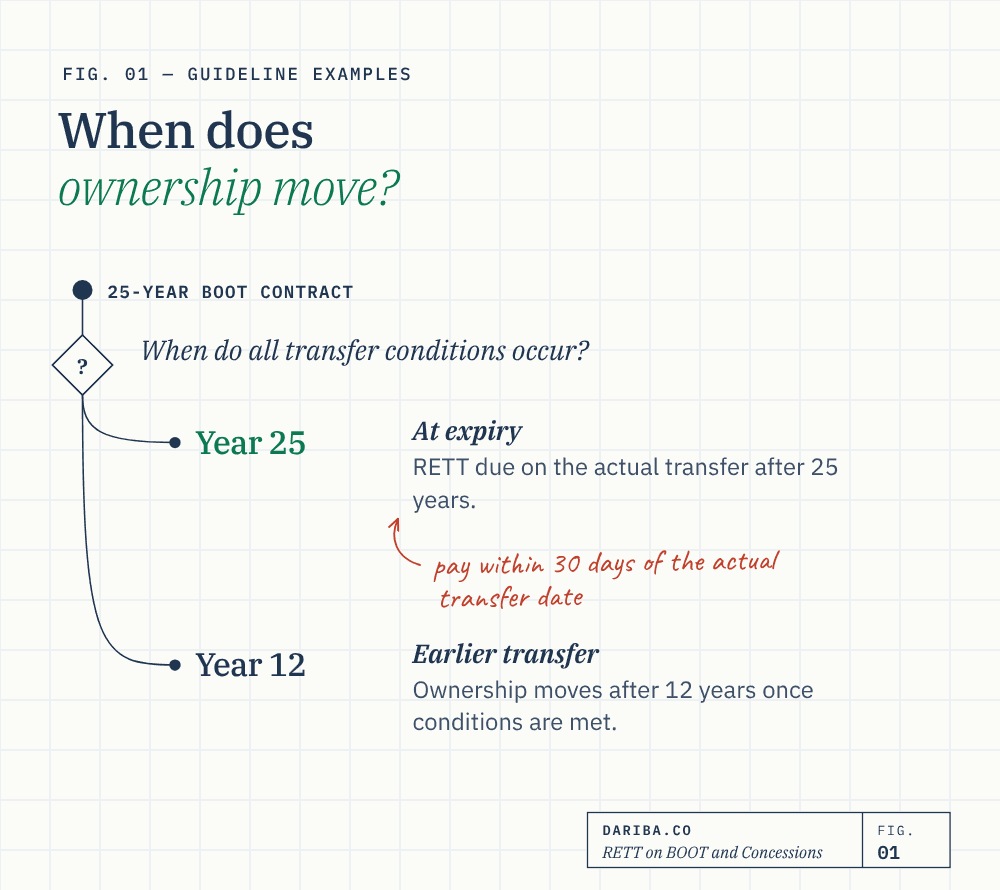
The practical question is therefore when ownership actually passes under the contract, supported by the rights and conditions. A physical handover certificate, a possession change or a scheduled expiry may be evidence; none is automatically conclusive if the ownership conditions say something different. Early termination needs the same fact-based analysis.
Payment is a separate step
Regulations Article 5(b) requires payment within 30 days of the relevant Article 4 transaction date for the applicable non-notarized transfer. The guideline’s section 4.3 table, printed page 20, expressly attaches the BOOT 30-day wording to the situation where notarization has not taken place.
Do not convert that rule into a universal right to pay 30 days after notarization. Law Article 5 sets the general payment rule, and the notarization process and any applicable specific exception must be respected. The assignor must resolve registration, exemption evidence or payment before completing the relevant formal steps.
Nor does a later administrative document automatically restart a clock that has already begun under Article 4(c). Keep a closing timetable based on the actual transfer conditions, not just the date someone intends to upload the documents.
Value the rights transferred at that date
Article 2(g) uses fair market value at actual transfer, rather than the project’s original construction budget or the original contract price. The relevant value is the real estate actually transferred. Establish the treatment of buildings, land rights and permanently allocated items under the Law and Regulations, including Article 2(b); a construction project’s whole accounting asset register is not automatically the RETT base.
Where the transferee already owns the land, establish precisely which additional rights or improvements pass. Do not tax a land ownership transfer that has not occurred, or assume that all equipment is excluded simply because it can be detached.
A financial model can estimate possible future RETT exposure, but cannot fix the future market value or guarantee that today’s law will govern a transfer decades later. Revisit the estimate and the legal analysis as the project progresses.
Public-sector relief: check the direction
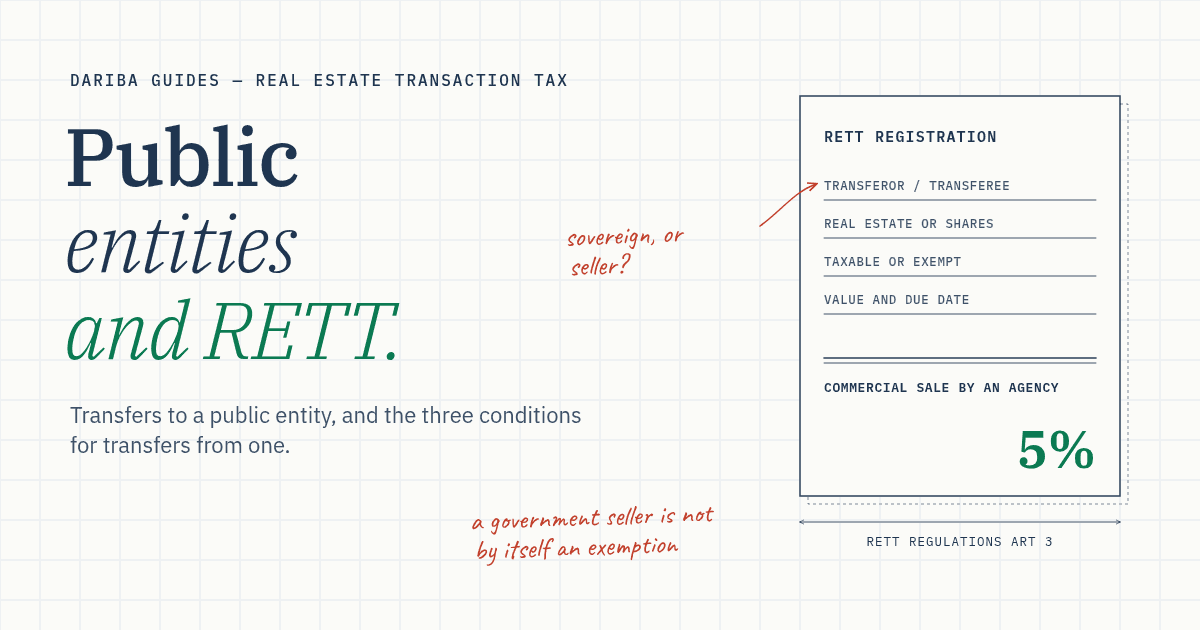
Regulations Article 3(a)(4) concerns transfers to a qualifying public entity, public legal person or specified public-benefit recipient. Article 3(a)(5) concerns transfers from a public entity acting in its public-authority capacity. These are separate routes.
The Article 3(a)(5) economic or commercial activity qualification should not be imported automatically into every Article 3(a)(4) receipt. Equally, a state-owned commercial company is not automatically a qualifying public legal person merely because its shareholder is government.
Identify the recipient and supporting constitutive instruments, direction of transfer and relevant exemption conditions. Government land, public funding or an infrastructure purpose does not by itself exempt the whole concession. See the public-recipient guide and public-entity overview.
Prepare for the actual transfer
Keep the contract and amendments, ownership-condition evidence, valuation scope and date, party identities, exemption basis and the registration/payment record in one transfer file. Identify the person for whose benefit the transfer is made under Law Article 7; an operator’s signature alone does not settle every taxpayer question.
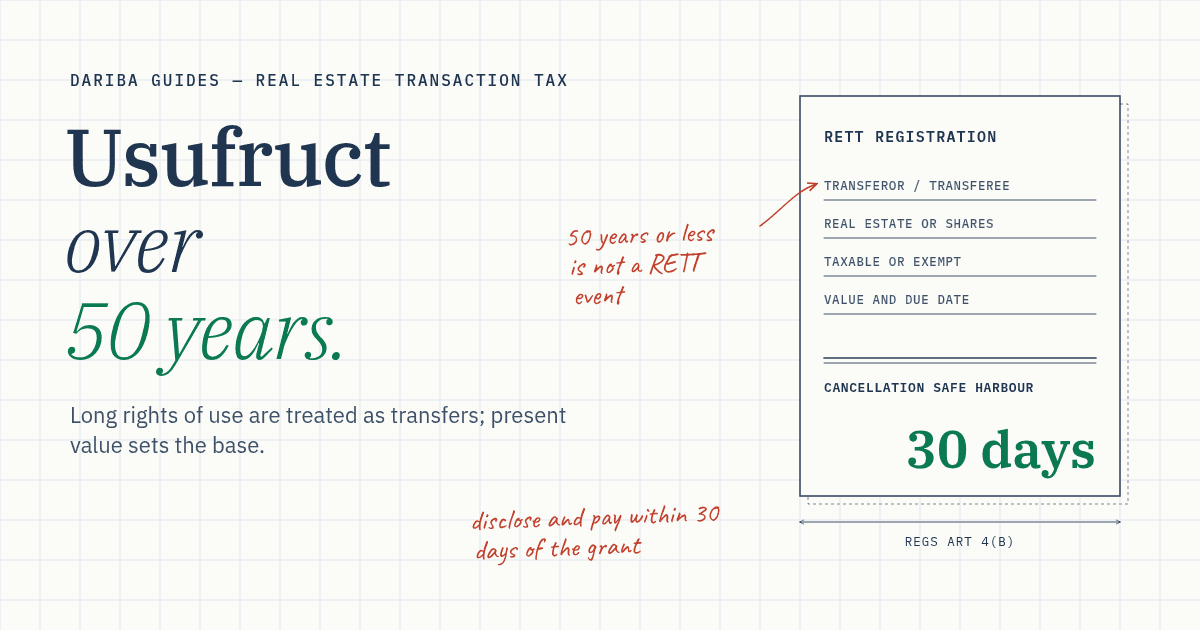
The Article 2(g) companion gives a numerical illustration. Where the project also grants a right of use beyond 50 years, use the usufruct analysis for that component rather than moving it automatically to the final BOOT date.
Key takeaways
- Article 4(c)'s specific timing rule operates for the relevant non-notarized BOOT transfer; all contractual ownership-transfer conditions matter.
- A planned concession expiry or physical handover does not replace evidence of actual ownership transfer.
- Article 2(g) uses the real estate's fair market value at the relevant actual transfer date.
- The 30-day payment rule in Article 5(b) is for the applicable non-notarized transfer; do not promise a universal post-notarization grace period.
- A separate initial acquisition or long usufruct needs its own RETT analysis.
- Public-recipient relief under Article 3(a)(4) is distinct from a public-authority grantor's Article 3(a)(5) relief.
Frequently asked questions
Does signing a BOOT agreement mean no RETT anywhere in the project until expiry?
No. The special ownership-transfer rule concerns the relevant taxable BOOT transfer. Initial land purchases, separate grants exceeding 50 years, share disposals and other transfers require their own analysis. The label BOOT does not defer all of them.
What if a 25-year concession transfers ownership after 12 years?
ZATCA's Example 12(B) uses that fact pattern. The actual transfer after 12 years, once all contractual transfer conditions are met, is the relevant date. The planned final concession expiry is not substituted for it.
Does a government company automatically make the handback exempt?
No. Establish the actual recipient and the qualifying public-entity or other relief conditions. State ownership or the public purpose of a project does not by itself establish that a company is a public legal person for Article 3(a)(4).
Sources
- ZATCA — Real Estate Transaction Tax Law (Arabic)Articles 1–3, 5 and 7
- ZATCA — RETT Implementing Regulations (Arabic)Articles 2(b), 2(g), 3(a)(4)–(5), 4(c), 5(b) and 11
- ZATCA — Detailed RETT Guideline, Version 6, May 2026Sections 4.2–4.4; Example 12, printed pages 17 and 19–21
Reviewed against the RETT Law, the controlling Arabic Implementing Regulations and ZATCA's Detailed RETT Guideline Version 6 (May 2026). The guideline does not amend the legislation. Historical transactions need their applicable-period analysis. General information, not transaction-specific advice. Dariba.co is independent of ZATCA.