In brief
Article 2(l)'s conditional taxed-once financing treatment, Law Article 2(2)'s financing-term cost exclusion and Article 3(a)(14)'s temporary-security exemption are separate rules. A bank substitution is neither automatically taxable nor automatically exempt.
Murabaha, Ijarah ending in ownership and finance leases can involve more than one title movement. The RETT result depends on the documented transactions and the applicable rule, rather than the product name alone.
Three rules to keep separate
| Question | Relevant provision |
|---|---|
| Is a qualifying financing transaction taxed again on completion? | RETT Implementing Regulations Article 2(l) |
| Does the base include licensed financing’s term cost? | RETT Law Article 2(2) |
| Is a temporary security or qualifying refinancing transfer exempt? | Regulations Article 3(a)(14) |
A failure to establish one route does not automatically answer the other questions. In particular, failing a taxed-once condition does not itself turn all financing-term cost into property consideration.
The conditional taxed-once financing route
Article 2(l) includes Murabaha, Ijarah for ownership and finance-lease transactions subject to stated conditions: the first transfer to the legally licensed financing entity is subject to tax; the financing contracts identify both transactions, their parties, property and value; and the property’s description and value remain as stated in the financing contracts.
ZATCA’s Detailed RETT Guideline, Version 6, sections 3.4 and 5.2, explains the financing treatment. Section 5.2, printed page 49, expressly discusses identified different parties in the linked financing transfers. Do not read the general unity principle as requiring the seller, bank and customer literally to be the same legal person.
Equally, the arrangement is not protected merely because it is economically one purchase. Read the actual contracts and first-transfer tax evidence. A separate new purchase cannot be relabelled as the completion of the original financing.
Financing-term cost and the proper property value
ZATCA’s Example 9, printed page 17, uses a SAR 1 million residential unit, approximately SAR 400,000 financing cost and SAR 1.4 million total payments over ten years. It selects the SAR 1 million property value, excluding the stated financing cost.
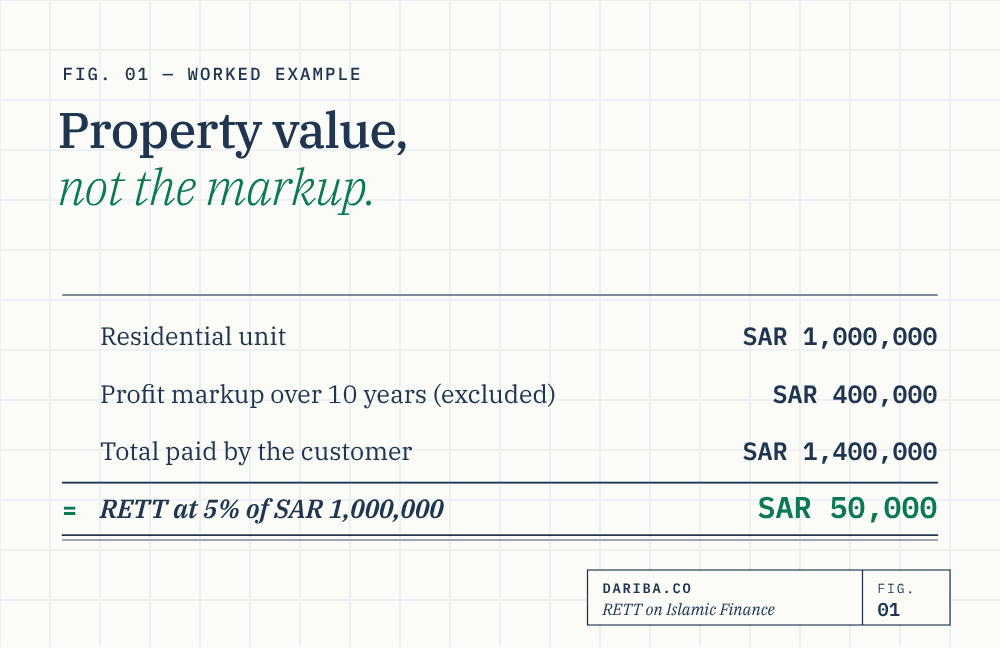
At 5%, that base gives SAR 50,000, calculated here by Dariba. Charging 5% on the full SAR 1.4 million would give SAR 70,000, a SAR 20,000 difference. The example is a financing-cost illustration; it does not identify every possible bank-finance product as a Murabaha contract.
The exclusion does not establish that the original agreed price is always the correct property base. Fair market value and the actual real-estate consideration still matter under Law Article 2 and the Regulations. Keep the property-price and financing-cost evidence distinct.
Refinancing requires a separate assessment
A change of bank does not automatically mean a second taxable sale. Examples 33–34, printed pages 32–33, illustrate temporary title movements within qualifying Ijarah refinancing and a portfolio transferred to a refinancing company. The continuing security arrangement and actual destination of the final title matter.
The reverse blanket claim is also wrong: not every bank-to-bank property sale, portfolio acquisition or securitisation qualifies merely because the institutions are licensed. Establish the temporary-security facts and conditions under Article 3(a)(14). See the security-transfer guide.
An investment fund’s custodian transfer uses the separate Article 3(a)(10) route. It is not a universal collateral exemption for every Islamic fund arrangement.
Default, permanent ownership and liability
A missed instalment or possession change is not automatically a new ownership transfer. Identify the rights already held and the legal effect of enforcement. ZATCA’s Example 32 concerns a temporary security arrangement becoming a permanent acquisition to recover debt.
Where a permanent transfer or sale occurs, test its chargeability, value and any other relief. A court-related enforcement sale does not automatically satisfy Article 3(a)(15)‘s bankruptcy liquidation conditions.
Under Law Article 7, identify the actual transferor and the person for whose benefit the transfer is made. A bank paying an invoice or a customer agreeing to bear the cost does not itself settle statutory responsibility.
Keep the two historical examples distinct
In Example 62, printed page 49, the developer paid 5% RETT on 5 December 2020, followed by the customer’s final transfer in 2030. The guideline applies the taxed-once financing rule to those facts.
By contrast, Example 35, printed page 34, concerns an Ijarah begun in 2012, with possession before RETT’s inception and title completion in 2022. Royal Decree M/84, Clause Fifth(1), concerns the stated lease contracts concluded before 14/2/1442 AH, 4 October 2020. It is not a blanket exemption for every contract signed before the new Law took effect in April 2025.
Keep the operative contracts, date and possession evidence, transaction chain, valuation split and tax records. The Article 2(l) companion develops the financing conditions.
Key takeaways
- The initial financed acquisition and later customer transfer need Article 2(l)'s actual conditions; the product name alone is insufficient.
- Both legs and their parties, property and value must be identified in the financing contracts.
- The licensing-based financing-term cost exclusion is a separate valuation rule, not a reward for satisfying every taxed-once condition.
- A mid-term bank transfer may qualify under the temporary-security/refinancing route; assess its facts rather than guarantee either outcome.
- Default, possession, permanent ownership and enforcement sale can be different events.
- Pre-RETT lease relief uses the 4 October 2020 inception cutoff, rather than a blanket before-10-April-2025 rule.
Frequently asked questions
Does a bank change automatically create a second RETT charge?
No. Reassess the actual transaction and the taxed-once conditions. ZATCA's Examples 33–34 separately illustrate qualifying temporary bank-to-bank and refinancing-portfolio transfers. Those examples also do not exempt every permanent sale or portfolio transaction involving a licensed institution.
Who owes RETT when a bank buys the property for a customer?
Law Article 7 generally places liability on the actual transferor and identifies the person for whose benefit the transfer is made. In an ordinary initial seller-to-bank sale, the seller is the transferor. A bank or customer may fund the tax contractually without automatically replacing that statutory taxpayer.
Is every amount paid over the financing term part of the property base?
No. Law Article 2(2) excludes financing-term cost in financing from legally licensed entities. Establish the underlying real-estate value, fair-market-value position and the nature of the amounts. Do not exclude property consideration merely by labelling it financing profit.
Does default itself mean the bank acquired property again?
Not necessarily. Establish the rights already held and what changes. A bank may already hold title under a financed purchase; possession or a missed instalment is not automatically another ownership transfer. Permanent acquisition under security or an enforcement sale needs its own analysis.
Sources
- ZATCA — Real Estate Transaction Tax Law (Arabic), Articles 2(2)–(3), 5 and 7
- ZATCA — RETT Implementing Regulations (Arabic)Articles 2(l), 3(a)(14)–(15) and 11
- Royal Decree M/84, RETT issuing instrument (Arabic)Clause Fifth(1), PDF page 2: pre-14/2/1442 AH lease contracts
- ZATCA — Detailed RETT Guideline, Version 6, May 2026Sections 3.4, 4.2, 5.1.9–5.1.10 and 5.2; Examples 6, 9, 31–35 and 62
Reviewed against the controlling Arabic RETT Law, Implementing Regulations, the operative issuing decree and ZATCA's Detailed RETT Guideline Version 6 (May 2026). Guidance does not amend legislation. Historical transactions need their applicable facts and period. Dariba illustrations assume their stated values and eligibility; general information, not transaction-specific advice.