In brief
A taxable ordinary sale generally bears 5% on its proper real-estate value. Establish the actual seller, relevant rights, valuation, relief and payment rules; related status, instalments, State support and cancellation each require distinct treatment.
An ordinary property sale is a common RETT transaction, but its tax should be established from the actual rights, value, parties and dates. The sale price, payment invoice and commercial tax allocation are related evidence, not interchangeable legal answers.
Identify the taxable sale and proper value
Law Article 2 and Article 2(a) of ZATCA’s RETT Implementing Regulations provide the 5% charge and valuation framework. A qualifying exemption must still be tested, even where the arrangement is a commercial sale.
The agreed real-estate value must be considered against fair market value and the applicable special rules. A cash price is not always the entire consideration; connected rights and qualifying permanently allocated items can matter.
Article 2(b)‘s movable-property rule does not depend solely on attachment. Detachability alone therefore does not prove that all fit-out or operating items may be excluded. Conversely, every business asset sold alongside a building is not automatically real estate. Support the actual classification and allocation.
A valuation review is not automatic acceptance
Regulations Article 8 gives ZATCA valuation powers in the stated circumstances, including related transactions and allocations involving other assets. Related status does not itself establish a mandatory new figure or an inevitable challenge.
Apply the actual related-person definition and its referenced instruments. Do not substitute the gift exemption’s family-degree list for every related-party valuation question.
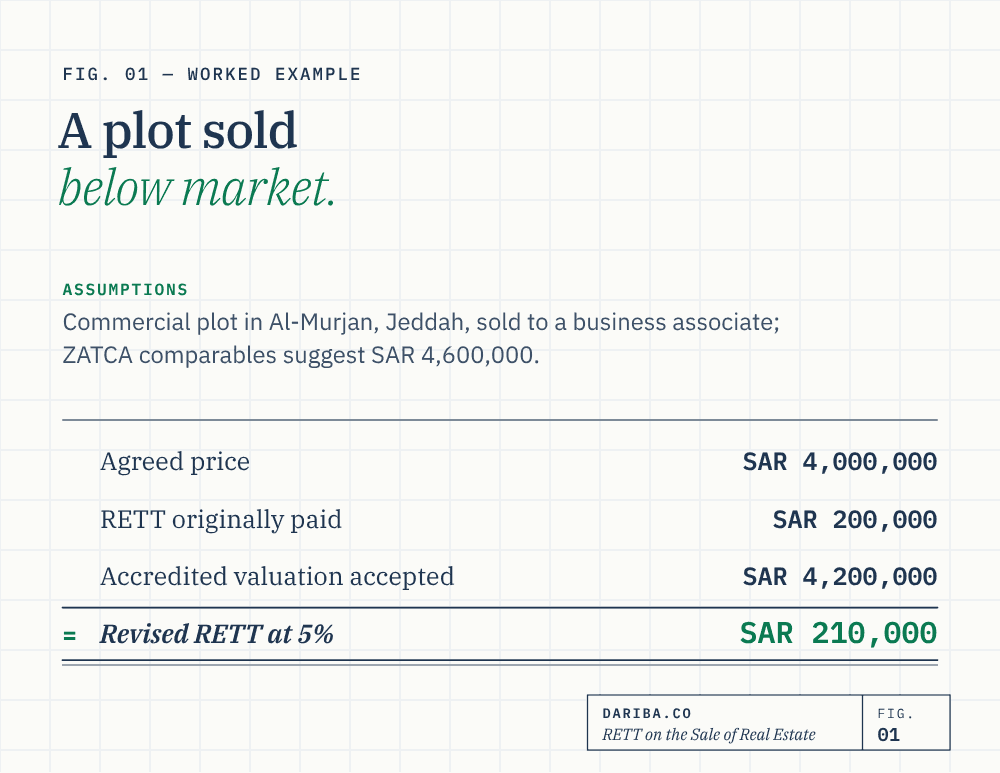
Dariba assumed illustration: a property is declared at SAR 4 million and SAR 200,000 tax is paid. If SAR 4.2 million is subsequently established as the proper value, the tax is SAR 210,000, a SAR 10,000 difference. If the proper value were instead SAR 4.6 million, the corresponding tax would be SAR 230,000.
An accredited report supports a position; it does not compel ZATCA to accept SAR 4.2 million rather than another established figure. Any adjustment, payment and fines follow the actual legal provisions and procedures, not an invented automatic valuation settlement.
Who is responsible?
Law Article 7 identifies the responsible transferor and, for that purpose, the person for whose benefit the transfer is made. In an ordinary owner-to-buyer sale the seller is the transferor.
The buyer may agree to fund tax commercially. That does not automatically substitute the buyer for the seller, or make the contractual allocation irrelevant between the parties.
Joint buyer responsibility depends on the statutory causal conditions. It should not be narrowed to deliberate price understatement alone: conduct causing nonpayment can include other actual failures. See the liability guide.
Instalments and payment timing
Receiving the price over time does not automatically divide one property transfer into a series of tax charges on receipts. Establish the actual transaction date, proper value and applicable payment rule.
For a Dariba illustration, assume one ordinary taxable notarized sale with a SAR 3 million proper base and no relief. Tax is SAR 150,000, even if the price is paid in three annual instalments. That assumption is not a ruling on every financing product or contingent-price arrangement.
Law Article 2(2)‘s licensed-financing term-cost exclusion is separate. An ordinary deferred price cannot simply be relabelled as excluded financing cost.
Use the actual ZATCA registration/payment process and applicable proof of payment or exemption for notarization. A non-notarized taxable transaction requires its relevant Article 4 date and Article 5 deadline; waiting for later paperwork does not automatically restart the clock.
First-home State support
The guideline’s section 6, printed page 50, describes verification of first-home support through the relevant service. It is State bearing of eligible tax, not a blanket Article 3 exemption or zero rate.
For a conditional Dariba illustration, assume a SAR 1.4 million proper home base and approved support covering the eligible first SAR 1 million of value. Gross tax is SAR 70,000, approved support is SAR 50,000, and the residual is SAR 20,000. Actual eligibility and approval remain necessary; see the first-home guide.
Assessment clocks and cancellation
Law Article 8 distinguishes the ordinary disclosed-transaction date from the knowledge-based position for an undisclosed or non-notarized transaction; continuing-condition and historical transition rules are separate. Do not describe every clock as three years from disclosure or discovery.
A completed sale later reversed is not automatically an incomplete transaction. The 90-day consensual-cancellation route requires its actual conditions, including the relevant notarized return, full value and unchanged description; the original-tax refund has a separate claim process.
Missing that route does not establish every independent refund ground, but it should not be described as an absolute bar to all possible claims. Use the refund guide and cancellation guide for those distinctions.
Key takeaways
- The seller's statutory position is distinct from contractual funding; buyer-caused joint liability is not confined to price fraud.
- Related-person status permits valuation scrutiny but does not itself supply an automatic mandatory value or guarantee a challenge.
- An accredited valuation is evidence, not an automatic promise of acceptance.
- Instalments do not automatically fragment RETT, but scope, proper base, financing costs and actual timing still matter.
- First-home support is State bearing of eligible tax, not a general statutory exemption.
- A failed 90-day cancellation route does not categorically eliminate every independently available refund ground.
Frequently asked questions
Can the buyer pay on the seller's behalf?
A commercial arrangement can fund payment without replacing Law Article 7's statutory taxpayer. Identify the actual transferor and person for whose benefit the transaction is made. Joint buyer liability depends on the statutory causal conditions, not merely who paid.
Does every related-party sale automatically use a different assessed value?
Related transactions are within ZATCA's valuation-review powers. Establish the correct fair-market-value position and actual procedures. Related status does not itself determine a particular figure, mandatory adjustment or inevitable reassessment.
Does paying the price in instalments defer RETT?
Not automatically. Identify the actual transaction date and payment provision and the proper full transaction value. Licensed financing-term cost has a separate exclusion; an ordinary deferred price should not simply be relabelled as financing cost.
Does a detachable item automatically fall outside the base?
No. Article 2(b) can treat owner-placed movable items permanently allocated to serve or exploit the owner's property as real estate even without permanent attachment. Establish the actual ownership, allocation and rights rather than rely on removability alone.
Is every cancellation after 90 days incapable of producing a refund?
The timely consensual-cancellation route has its own conditions. Failure of that route does not prove every other ground, but neither does it eliminate a genuinely independent overpayment, error or other applicable claim. Establish the actual ground and procedure.
Sources
- ZATCA — Real Estate Transaction Tax Law (Arabic)Articles 1–3, 5–9 and 14 as relevant
- ZATCA — RETT Implementing Regulations (Arabic)Articles 1–5, 7–9 and 11
- ZATCA — Detailed RETT Guideline, Version 6, May 2026Sections 1.3, 3.4, 4.1–4.5 and 6; Examples 1 and 7–9
Reviewed against the controlling Arabic RETT Law and Implementing Regulations and ZATCA's Detailed RETT Guideline Version 6 (May 2026). Dariba illustrations assume stated rights, values and eligibility. Actual scope, exemption and historical-period requirements need their own evidence. General information; Dariba.co is independent of ZATCA.