In brief
France uses conditional allocation rules rather than a single country rate. Establish the recipient, actual income and activity, applicable MFN/MLI text, tax-base treatment and procedure before claiming relief.
A payment to a French recipient needs a Saudi domestic classification and a separate France treaty analysis. The domestic starting category is not the treaty outcome. The Saudi–France convention uses its own allocation rules, activity connections, most-favoured-nation (MFN) provisions and safeguards; it should not be reduced to a borrowed table of dividend, interest and royalty percentages.
This guide brings together the main withholding-payment categories and the focused France guides. It is a source-reviewed decision framework for the stated provisions, not certification of every historical instrument, special transport agreement or taxpayer claim. The WHT finder must be read with those limits.
Establish residence, covered tax and the relevant period
Articles 1–4 identify covered persons, taxes, definitions and residence. A French invoice address, group parent or bank account does not establish that the actual recipient is a treaty resident. An individual’s dual-residence analysis follows Article 4(2)‘s sequence. Article 4(3) addresses a dual-resident non-individual by effective management; Saudi Arabia reserves against MLI Article 4, so a generic MLI competent-authority tie-breaker should not silently replace the applicable treaty provision.
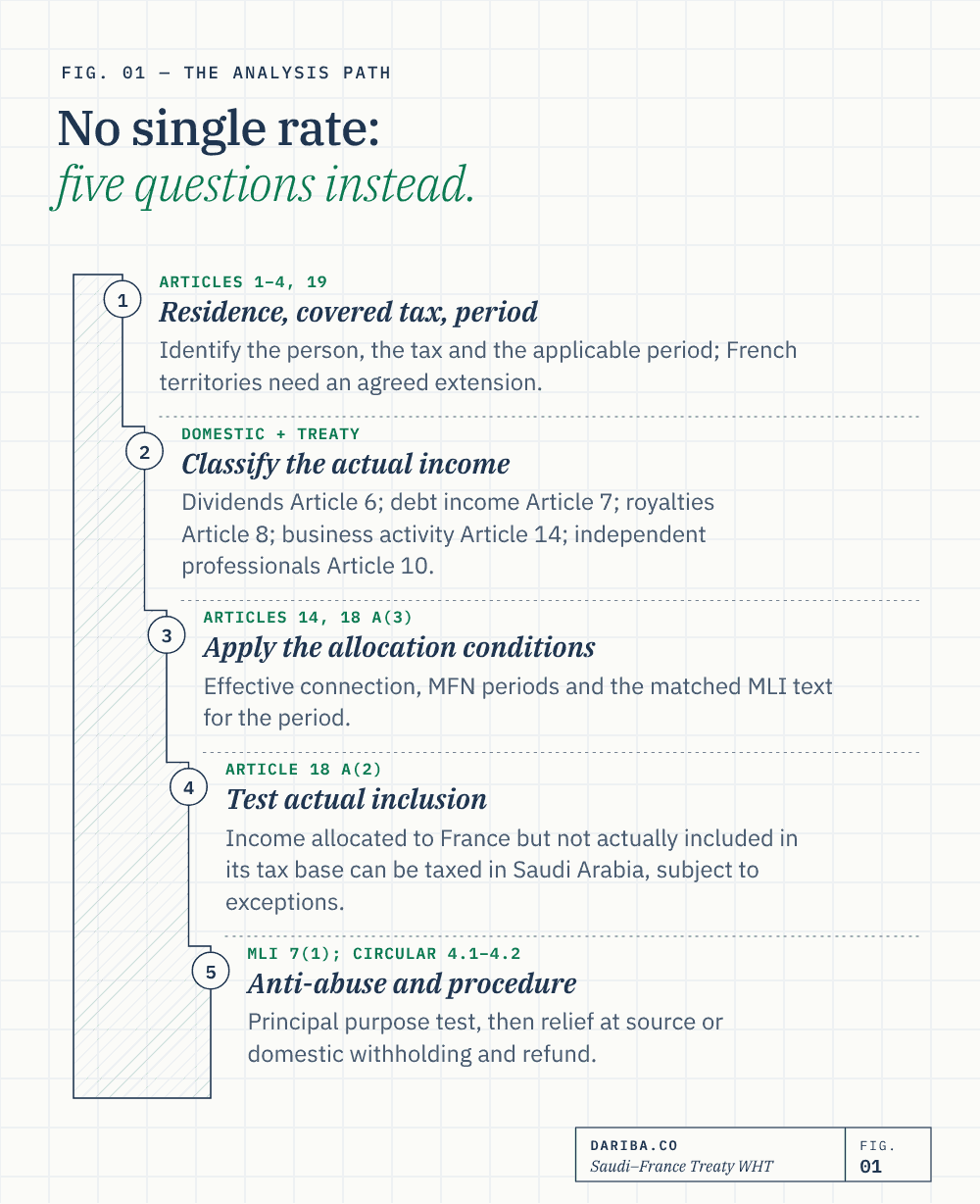
Article 19 also matters: French departments and territories requiring an agreed extension are not interchangeable labels. Identify the recipient’s actual jurisdiction, residence and the covered tax. A reference to Zakat in Article 2 does not convert this WHT guide into a Zakat computation or extend an income-tax allocation to VAT.
The French administration’s current commentary records renewal for five years from 1 January 2024. Its MLI/MFN consolidation is a reading aid; the authentic convention, amendments and applicable matched MLI provisions govern. The consolidation’s Article 20 note distinguishes MLI effect for withholding events from 1 January 2021 and other relevant tax periods beginning from 1 November 2020. Historical transactions require their actual version and effect-date analysis.
Sources: consolidated Articles 1–4 and 19–20, pp. 6–7 and 17–18; Saudi MLI position, Article 4 reservation, p. 15; current French official commentary, paragraph 1.
Classify the eleven finder categories using the actual income
The following map is Dariba’s original navigation analysis, not an official ZATCA rate table. It starts after source, recipient, domestic charge and category have been established under Income Tax Law Articles 5 and 68 and Implementing Regulations Article 63. Each row retains the treaty’s own conditions and any applicable domestic exclusion.
| Payment selected in the finder | France treaty route to examine | Conditions that prevent an automatic rate answer |
|---|---|---|
| Dividends | Article 6 and its distribution definition | Residence-State allocation; effectively connected shareholding can lead to Article 14. Article 18 A(2) expressly excludes dividends. |
| Interest or loan charges | Article 7 and Protocol paragraph 1 | Actual debt income, recipient and activity connection; apply the actual-inclusion safeguard where relevant. An independent fee is not automatically debt income. |
| Royalties or licence fees | Article 8, read with ZATCA Policy W-24-38 | Actual defined right, residence and effective connection; retain Article 18 A(2) and anti-abuse review. |
| Management fees | Article 14 according to actual industrial or commercial activity | Do not automatically give all management work the technical-service duration test. Attribution and actual functions matter. |
| Technical or consulting services | Article 14(3) for qualifying enterprise services; Article 10 for an individual’s independent activity | Identified MFN periods and wording differ. Export-linked work and mixed contracts require Article 14(2)/(4) analysis. |
| Insurance or reinsurance | Article 14 for the actual business income unless a separate income provision governs a component | The domestic premium category does not prove a treaty percentage or an automatic exemption. |
| Rent or equipment leasing | Article 5 for immovable property; identify the appropriate business, debt or rights provision for other property/components | Equipment use is not automatically included in France Article 8 merely because another treaty includes it. |
| Air or sea freight and tickets | Article 14 and the actual contract, with Protocol paragraph 1 separately examined for airline profits | The airline-specific suspension and special-agreement condition cannot be assumed from a ticket purchase. Crew employment Article 10 A(2) is a different rule. |
| International telecom | Article 14 or the provision governing the actual component | Retain domestic Article 63(5)‘s specified exclusions; do not reclassify every network or licence payment as a royalty. |
| Land transport | Article 14 and the actual activity/source | The domestic residual category and treaty attribution are separate. A country selection does not settle source. |
| Other services | Actual Article 14/10 or other governing income provision | A residual domestic category is not permission to apply a royalty result to an unrelated service. |
Sources: current Arabic Regulations, Article 63, pp. 34–35; treaty Articles 5–14 and Protocol 1, consolidated pp. 8–13 and 20; ZATCA policy, W-24-38, p. 51. For detailed classifications use the dividend/debt guide, royalty guide and business-activity/MFN guide.
Keep dividend, debt and royalty allocations conditional
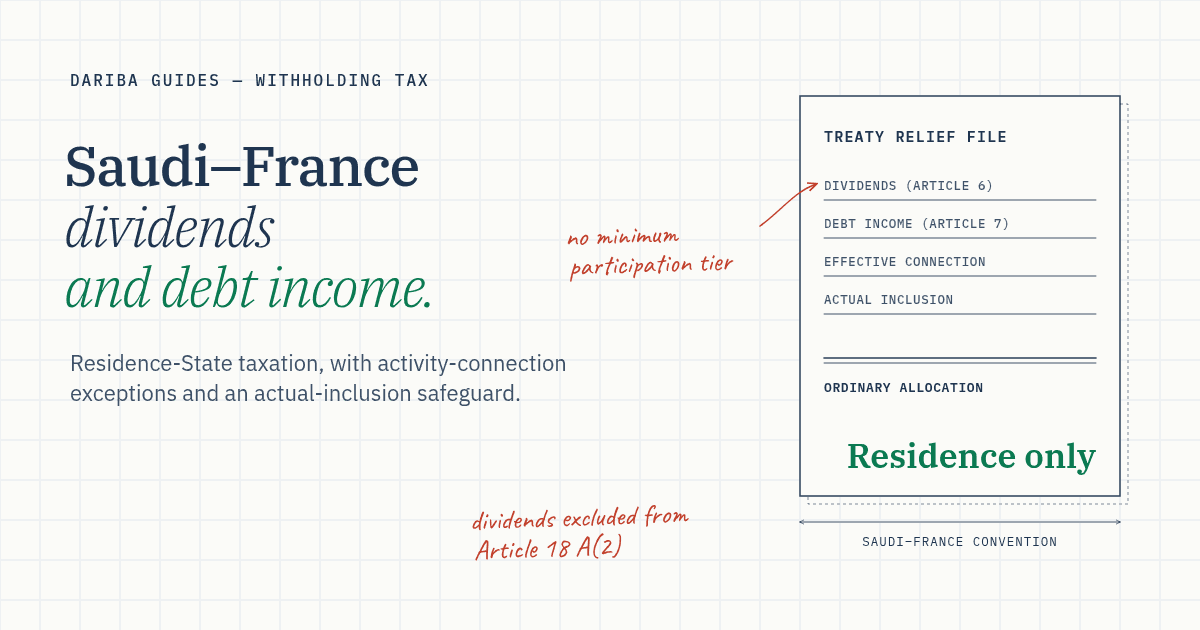
Articles 6(1) and 7(1) generally reserve the stated dividends and debt income to the recipient’s residence State. Their second paragraphs separately address the generating participation or claim being effectively connected with the recipient’s industrial or commercial activity in the source State and direct that case to Article 14. Do not import another treaty’s corporate holding bands into Article 6.
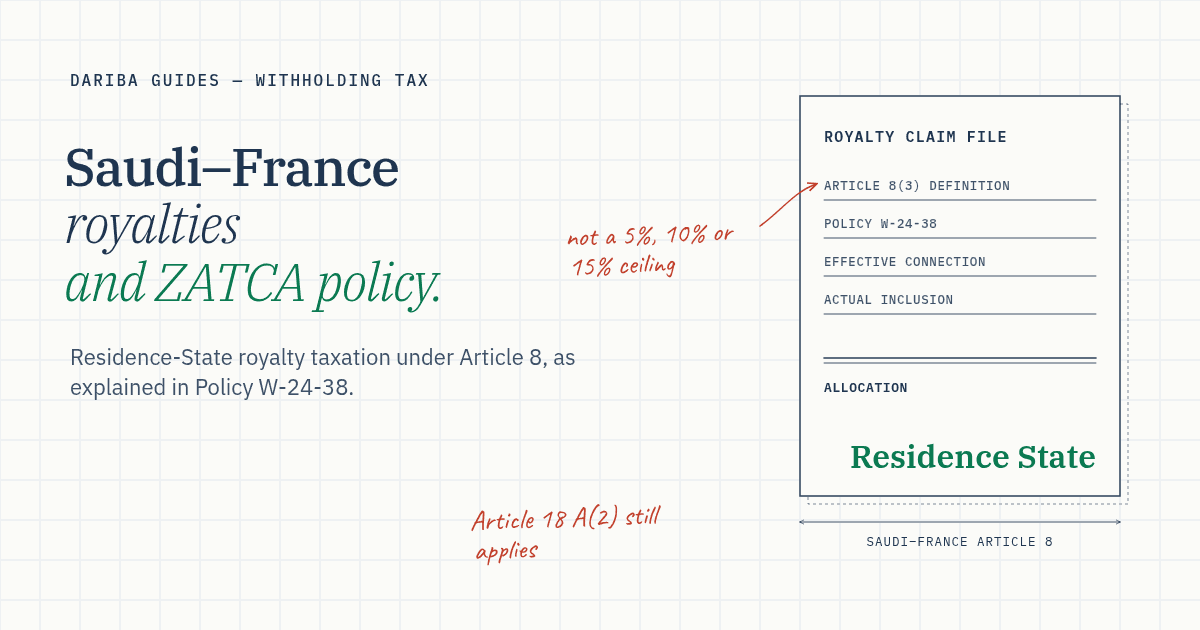
Article 8 needs the actual right and ZATCA’s specific published explanation. Policy W-24-38, adopted on 19 September 2024 and retained in the September 2026 fourth-edition collection, explains residence-State exclusivity for the selected royalty provision, with the effectively connected source-State activity exception. The French Article 8(1) does not repeat the exact exclusive wording used in Articles 6 and 7; the specific ZATCA policy is therefore identified, rather than silently paraphrasing all three texts as identical.
This does not remove Article 18 A(2) or decide whether a SaaS, licence, equipment, know-how, service or outright transfer actually falls in Article 8. The customer using a right in Saudi Arabia is not, by itself, proof of the French recipient’s connected Saudi activity.
Sources: authentic Articles 6–8, pp. 3–4, Arabic Article 8, p. 6 and Policy W-24-38, p. 51.
Apply the business framework and MFN period to the actual activity
Article 14(1) addresses attributable profits from industrial or commercial activity. Its selected project and service paragraphs are not a generic permanent-establishment clause copied from another convention. The French consolidation displays a continuous period exceeding twelve months for Article 14(2)‘s specified project-linked activities, and a continuous period exceeding six months within twelve months for Article 14(3)‘s specified services. The identified Turkey and Austria MFN source chains must be retained; neither imports every provision of those treaties wholesale.
Article 14(4) separately addresses export profits and mixed export/other contracts. Paragraphs (5)–(7) preserve the stated sole-purpose activities, expense and internal-charge controls, corresponding adjustment and separately governed income. A short project, an offshore invoice or one export component does not independently certify that every receipt is outside Saudi taxation.
An individual’s independent-profession Article 10(1) instead uses at least 183 days in the specified twelve-month period. Employment Article 10 A has its own more-than-183-day fiscal-year limb and resident-employer alternative. The work/study/research guide explains those distinctions. Do not turn months into an invented universal day count or a corporate invoice into an individual’s professional-income claim.
Sources: consolidated Articles 10 and 14 with their MFN footnotes, pp. 10–13; Saudi–Austria Article 5(3)(b), p. 7; Saudi–Turkey Articles 5(3)(a) and 14, pp. 6 and 18. The linked business guide retains the continuous/aggregated wording boundary and historical amendment-date uncertainty.
Preserve the actual-inclusion and government-investment distinctions
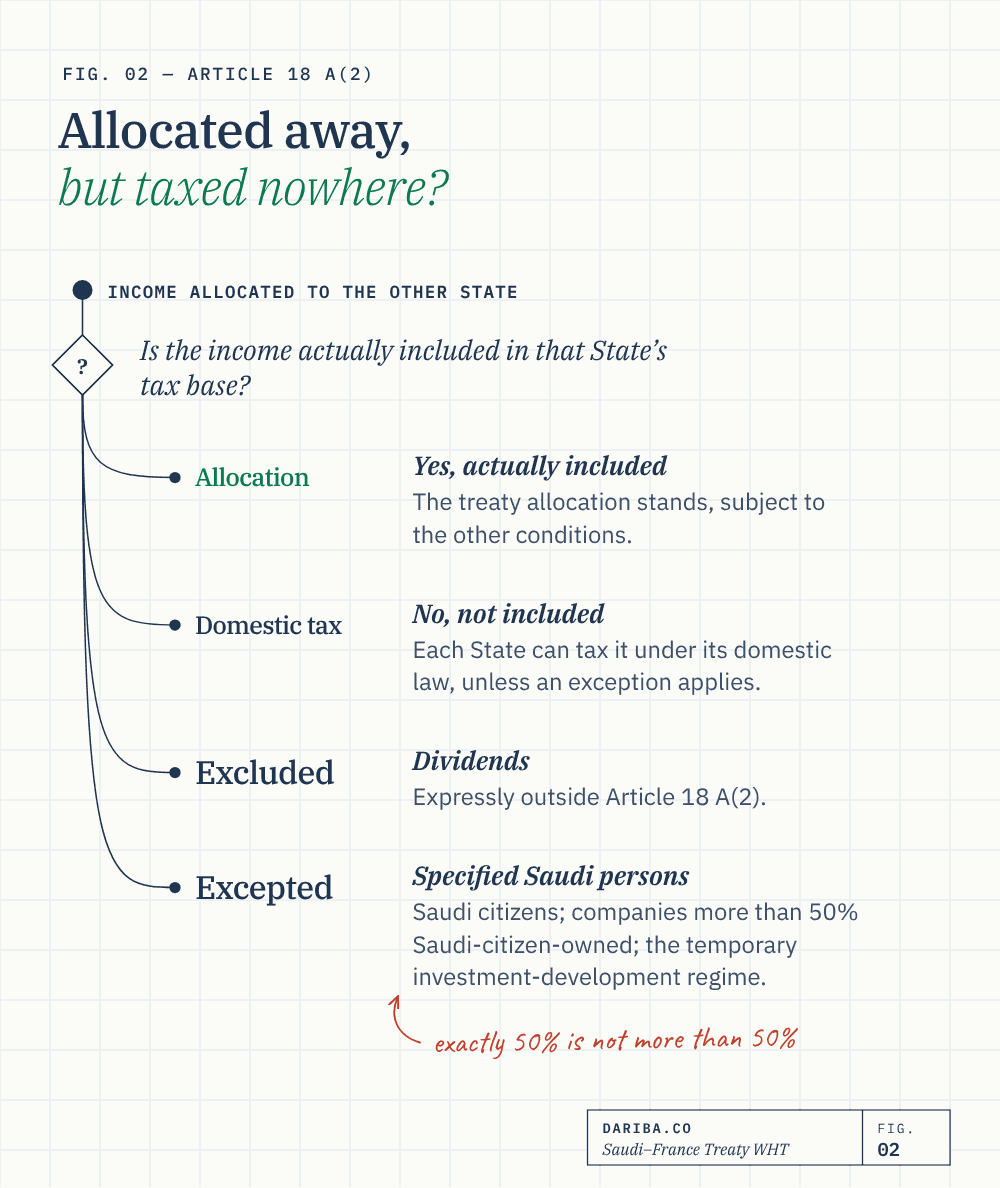
Article 18 A(2) addresses income allocated to the other State that is not actually included in that State’s tax base. It expressly excludes dividends and contains exceptions for Saudi citizens, companies more than 50% directly or indirectly Saudi-citizen-owned, and the stated Saudi temporary investment-development exemption regime. Exactly 50% is not more than 50%. Residence evidence, actual inclusion and the particular exception are separate questions; do not invent a universal minimum positive cash-tax rate.
Article 18 A(1) is a different provision: it addresses a contracting State’s investments in the other State, including the central bank and public institutions, and related income/gains, while excluding immovable property and its income. A business describing itself as government-linked does not independently prove every condition. Do not substitute the ownership wording of paragraph (2) for paragraph (1)‘s investment analysis.
Protocol paragraph 1 also addresses debt income arising in a State and paid by a national of either State to a bank or financial institution of either nationality. Record the actual payer, debt and institution facts. This is not permission to treat every platform fee or group financing receipt as exempt interest.
Sources: Article 18 A, p. 16 and Protocol 1, p. 20, read with Article 7 and the dividend/debt guide.
Check anti-abuse, relief and dispute procedures separately
The MLI Article 7(1) principal-purpose test may deny a treaty benefit where obtaining it was one of the principal purposes, unless granting it accords with the relevant provisions’ object and purpose. Identify actual ownership and commercial functions, the receipt and transaction purpose; a residence certificate alone does not settle benefit entitlement.
ZATCA’s treaty-withholding circular sections 4.1–4.2 distinguishes relief at source and domestic withholding followed by a refund. Keep the actual required forms, residence evidence, authentication/Apostille conditions, undertakings, approval and payment/refund records. A pending application is not approval. The procedure guide supplies the detailed evidence path.
Article 18, read with matched MLI Article 16, provides the selected either-authority route and three-year period from the first notification of taxation contrary to the treaty. That MAP period is not a substitute for every domestic filing, objection or refund deadline. Article 15 separately addresses double-taxation relief; do not assume a French credit or exemption without applying its actual income and ownership conditions.
Sources: MLI Article 7(1), pp. 9–10; consolidated Articles 15 and 18, pp. 14–15; ZATCA circular section 4, pp. 15–17.
Retain a payment file and the unresolved instrument boundaries
Dariba recommendation: retain the actual contract and components; recipient and residence evidence; domestic source/category memorandum; treaty article and MFN/MLI version; activity and day/month schedules where relevant; tax-base inclusion or an express exception where relevant; anti-abuse evidence; claim and decision; and actual remittance/refund records. Preserve evidence of a domestic exclusion even where a treaty claim is unnecessary.
The treaty Protocol’s airline-profit suspension is conditional on a specific airline agreement. This review does not establish the current separate agreement chain or certify an airline’s entitlement. It also does not certify inheritance/wealth outcomes, every historical renewal/amendment, all possible later MFN triggers or a particular person’s French tax computation.
The current OECD status list links France’s September 2020 consolidated position and a later Article 35 notification. The latter’s operative text concerns Germany, so its 2024 date should not be transplanted into the Saudi treaty. The official consolidated reading aid already identifies the relevant 2020 French notification. The linked later OECD documents were readable through the web source but direct byte retrieval failed; their independent download hashes are not claimed. Preserve these evidence limits when evaluating an actual historical period.
Use this country guide to identify the right analysis and supporting companion, not to turn an indicative domestic starting category into a final treaty rate.
Key takeaways
- Country selection does not establish treaty residence or a final withholding rate.
- Dividends and debt income have distinct activity-connection conditions.
- Royalties require Article 8 classification and the identified ZATCA policy.
- Management, technical, insurance, leasing, transport and telecom payments need their actual income route.
- Article 18 A(2) excludes dividends and retains its express Saudi exceptions.
- MFN periods, actual inclusion, anti-abuse and claim procedures remain separate checks.
- The airline agreement chain, every historical period and all other tax outcomes remain outside this focused assurance.
Sources
- French tax administration: MLI/MFN consolidated treatyReading aid: Articles 1–20 and Protocol; selected pp. 6–20. Authentic instruments govern.
- French tax administration: authentic convention compilationArticles 1–20 and Protocol; older MFN period text distinguished from identified current applications.
- ZATCA: authentic Arabic Saudi–France treaty publicationArticle 8 and selected scope, income and safeguard wording read with French text.
- ZATCA: policies and procedures on major dispute itemsFourth edition September 2026, Policy W-24-38, p. 51; specific royalty interpretation, not legislative amendment.
- Saudi Income Tax Implementing Regulations, Arabic textArticles 5 and 63: source/category, domestic exceptions and payment obligations.
- Saudi Income Tax Law, Arabic textArticles 5 and 68: domestic framework distinct from treaty allocation.
- ZATCA: treaty-withholding implementation circularJanuary 2025, sections 3.2 and 4; classification and actual relief/refund procedures.
- ZATCA: Saudi–Austria treatyArticle 5(3)(b), p. 7, identified MFN service-period source; no wholesale import.
- ZATCA: Saudi–Turkey treatyArticles 5(3)(a) and 14, pp. 6 and 18, identified MFN project/personal-service sources.
- OECD depositary: Saudi MLI deposited positionArticle 4 reservation and selected matched provisions; unilateral options do not determine modification.
- OECD depositary: France MLI deposited positionCovered agreement and selected matched provisions, read with the official consolidation’s 2020 notification note.
- OECD: authentic English MLIArticles 7, 16, 17 and 35; substantive provisions and effect-date framework.
- OECD: current MLI signatories and partiesFrance/Saudi dates and links to later positions; treaty entry into effect remains separate.
- French official treaty commentary BOI-INT-CVB-SAUParagraph 1: renewal from 1 January 2024; current official page checked 6 November 2026.
- OECD: France consolidated MLI position, September 2020Official web text read; direct download returned 403, so independent byte/hash verification is not claimed.
- OECD: France Article 35 notification deposited November 2024Operative notification concerns Germany, not a new Saudi effective date. Official web text read; no independent downloaded hash.
General information from selected official treaty, MLI and Saudi sources reviewed 6 November 2026. Actual recipient, residence, income, activity, period, inclusion, exceptions and procedure determine treatment. The consolidation is a reading aid. Dariba navigation analysis is original; no final taxpayer rate, complete historical instrument chain, special airline entitlement or independent legal certification is implied.