In brief
Assess Saudi-source loan returns, interbank conditions, syndicated payment chains, gross-up and treaty evidence using current official Saudi guidance.
Saudi WHT generally uses the current 5% domestic loan-return category for in-scope payments to a non-resident. Establish what is consideration for using money, whether the income has a Saudi source and who actually receives it. Principal repayment, a financing return, management/arrangement services and a distribution are not interchangeable labels.
Identify the actual return on the use of money
Regulations Article 5(1), p. 5, defines loan returns broadly as amounts for the use of money, including lending income whether secured/unsecured and whether or not there is a right to participate in the debtor’s profits, including relevant government/non-government bonds.
Article 63(1), p. 34, sets the domestic loan-return rate at 5% for payments within withholding scope. ZATCA’s General Withholding Tax Guideline, second version May 2026, section 2.2.2.2, pp. 21–22, explains the category.
Do not apply the percentage to a loan’s full outstanding principal merely because principal is repaid alongside the financing return. Equally, a fee’s commercial name does not establish it is principal or excludes it from income.
Apply the three stated Saudi-source routes
Article 5(1) treats the relevant non-resident loan return as Saudi-source where the debt is secured by movable/immovable property in Saudi Arabia, the borrower is Saudi-resident, or the loan relates to activity through a Saudi permanent establishment.
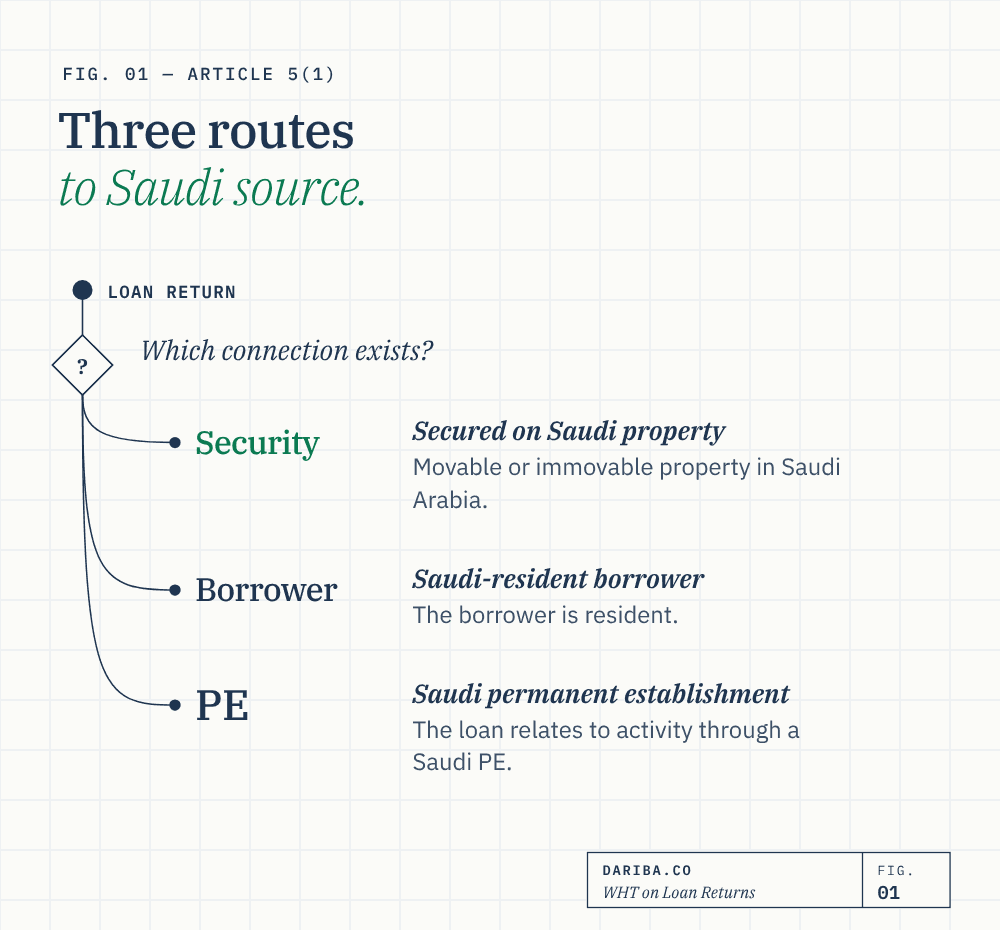
The tests concern the actual debt/borrower/security/activity. Paying from an offshore account does not automatically change source, and a foreign currency does not itself remove Saudi withholding.
Dariba analysis: retain the borrower, lender, debt terms, security and use/activity connection. A group treasury entity acting as collection agent should not automatically be treated as the lender entitled to every treaty benefit.
The interbank-deposit exclusion is narrowly conditional
Article 5(1)‘s interbank provision and guideline p. 21 address returns on deposits between banks held with the resident borrowing bank for a maximum of 90 days, subject to the prescribed annual statement certified by the Saudi Central Bank, identifying lenders, addresses, duration and returns.
This is not an exclusion for every corporate cash-pool balance, short shareholder loan or bank payment. Establish the actual interbank deposit and all documentary/period conditions.
Do not infer a general rule that only the days exceeding 90 are taxable where the stated conditions fail. The actual arrangement and applicable rules must determine the consequence; a threshold is not automatically a tax-free tranche.
Syndicated lending requires the payment chain identified
The guideline’s loan-return discussion, pp. 21–22, distinguishes payment through a resident lead bank from payment to non-resident participating banks. A resident manager includes its actual income under its relevant tax/Zakat route, while its onward loan-return payments to non-resident banks require withholding.
Where the lead bank is non-resident, the guideline discusses the payment covering the syndicate’s loan returns. The role and payment chain matter; a resident intermediary does not automatically exempt all underlying non-resident income.
Dariba recommendation: identify the actual lenders, lead bank’s capacity, participant allocations, separate service fees and certificates. A single payment instruction may settle several parties’ income without establishing that one party owns all of it for treaty purposes.
Calculate from the relevant gross loan return
Article 63(8) applies withholding to the full relevant amount without deducting the recipient’s expenses. Dariba original assumptions: principal of SAR 1 million is repaid together with a separate SAR 60,000 gross loan return within scope at 5%, without relief. WHT on that return is SAR 3,000; the principal repayment is not itself treated as the loan return.
The assumption does not classify every discount, premium, guarantee or arrangement fee as loan-return income. Determine the actual consideration and any independent service before applying the rate.
The borrower’s income-tax/Zakat deduction requires its own rules. Paying WHT does not prove that a financing expense is fully deductible or that all related-party pricing conditions are met.
Net-return promises and treaty relief change the required analysis
Dariba original illustration: an expressly net SAR 95,000 loan return, with the borrower bearing a 5% withholding obligation and no relief, gives SAR 100,000 gross consideration and SAR 5,000 tax. Confirm the tax-bearing clause; simply adding 5% to the promised net amount does not solve the same calculation.
An applicable treaty can modify the domestic result if the actual article, recipient/residence, relevant connection and procedural conditions are satisfied. A foreign banking licence or generic residence certificate does not alone establish every element.
No universal treaty percentage, automatic direct-relief procedure or foreign-tax-credit outcome is certified here. Assess the actual lender/payment period rather than select a rate from the country of the group treasury office.
Distinguish distributions, services and VAT treatment
A shareholder payment can be a loan return, distribution, repayment or actual service consideration depending on its legal/economic facts. The domestic dividend category has separate definitions and exceptions under Article 63(6); calling equity funding a loan is not a final classification.
Independent management, technical or arrangement services require their actual categories considered. An amount invoiced with interest is not automatically loan-return income merely because one document combines them.
VAT on financial services is separate from withholding. A financing return’s VAT exemption does not establish an income-tax/WHT exemption; an explicit service fee can have its own VAT and WHT questions.
Retain the financing-to-return reconciliation
Keep the executed loan/deposit documents, lender/recipient, borrower residence, security/activity connection, principal/return schedule, actual settlement, gross/net terms, interbank evidence where relevant, treaty support, statements, payments and certificates.
The main WHT guide and compliance guide explain the payer and reporting framework. Non-cash offsets can require payment analysis even where the loan balance is settled through group treasury.
Dariba recommends separating principal, returns and independent fees in both contracts and accounting records. That produces a calculation grounded in the actual financing arrangement rather than a withholding rate applied indiscriminately to every cash movement.
Key takeaways
- Apply the current 5% category to actual in-scope gross loan returns.
- Saudi borrower, Saudi security and Saudi permanent-establishment activity are distinct source routes.
- The interbank-deposit exclusion has specific bank, period and statement conditions.
- Identify actual lenders and intermediary roles in syndicated payments.
- Principal, independent services, distributions and VAT require separate analysis.
Sources
- Official Arabic Income Tax Implementing RegulationsArticles 5 and 63, pp. 5-6 and 34-36: source, current categories, gross base and reporting. Read with actual contract and recipient facts.
- ZATCA General Withholding Tax GuidelineSecond version May 2026, section 2.2.2.2, pp. 21–22: loan returns, interbank conditions and syndicated payment chains; rates/reporting pp. 28–31.
General information only. Actual supplies, facts, applicable periods and controlling Arabic legislation determine the result. Official examples are distinguished from Dariba analysis and original illustrations. Seek advice or clarification where the arrangement or source material leaves a specific issue unresolved.