In brief
Electronic acceptance does not determine every VAT consequence. Correctly issued simplified invoices can support eligible deductions, fully exempt supplies are excluded, and statutory adjustment rules govern the return period.
E-Invoice Acceptance and VAT Liability Answer Different Questions
FATOORA records the clearance and reporting of electronic documents. The VAT return declares the tax consequences of transactions. These systems are closely connected, but acceptance of an invoice does not independently establish the correct tax treatment, and rejection does not erase a taxable sale.
Implementation Resolution First 3 addresses electronic invoices as deduction evidence in accordance with the applicable requirements and implementation dates. Technical Guideline section 4 and its VAT-return FAQ separately explain that VAT becomes due on the underlying transaction even if a valid invoice was not issued. Finance must therefore monitor both the document status and the transaction’s VAT treatment.
This distinction prevents two opposite errors: omitting a taxable sale because its XML failed, and treating an accepted invoice as proof that an exempt-use or otherwise restricted input is deductible.
Establish the Applicable Integration and Evidence Requirements
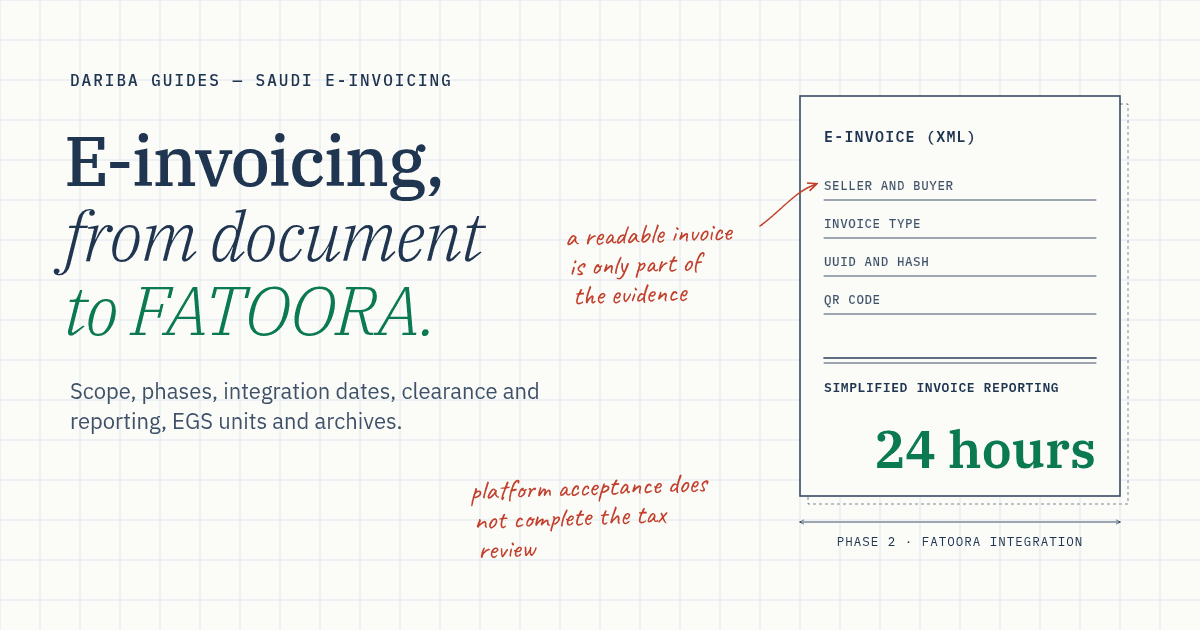
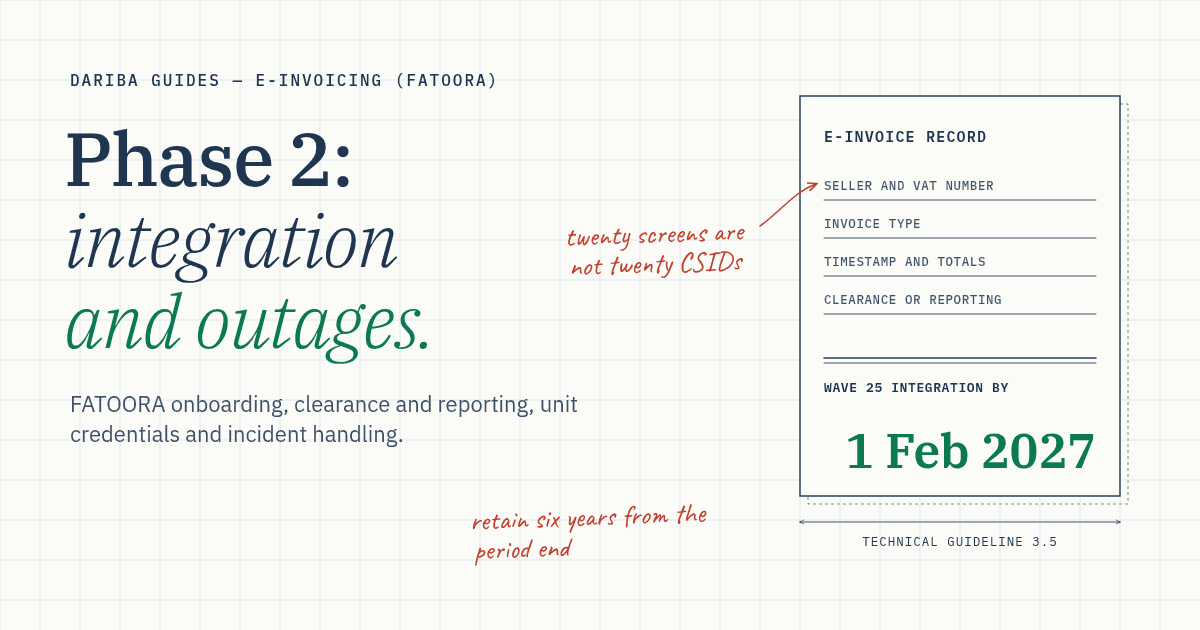
The Resolution must be read with the taxpayer’s actual integration obligation and VAT Implementing Regulations Article 49. The standard Phase 2 route requires clearance before providing the standard invoice to the buyer; simplified documents follow reporting within 24 hours of generation. The Phase 2 guide explains the document-specific processes and qualified incident procedures.
A buyer should examine the document received, relevant supplier status and date, underlying supply and deduction conditions. Missing required clearance is a material evidence issue. Obtain corrected evidence and investigate the reason rather than treating the document as equivalent to a fully cleared invoice.
However, neither an accepted warning nor a temporary technical problem proves that input VAT is permanently lost. Resolution First 3, the applicable incident rules and Article 49’s evidence routes must be reconciled for the actual case. The Detailed Guideline’s qualified bank outage scenario even describes an interim VAT invoice pending prompt delivery of the compliant cleared replacement; that scenario should not be extended into a general permission to bypass clearance.
Dariba illustration: A purchaser receives an equipment invoice while the supplier is experiencing an integration failure. The purchaser should verify the relevant date, preserve correspondence and obtain the compliant document or clarification of the applicable evidence route. The purchase amount alone does not establish a fixed assessment, surcharge or permanent denial. This illustrates a review process, not an assumed ZATCA audit outcome.
Correctly Issued Simplified Invoices Can Be Deduction Evidence
Article 49(7)(a) expressly recognises a correctly issued simplified tax invoice among the alternative deduction evidence categories. It is therefore incorrect to state that a business buyer can never recover VAT because the invoice is simplified.
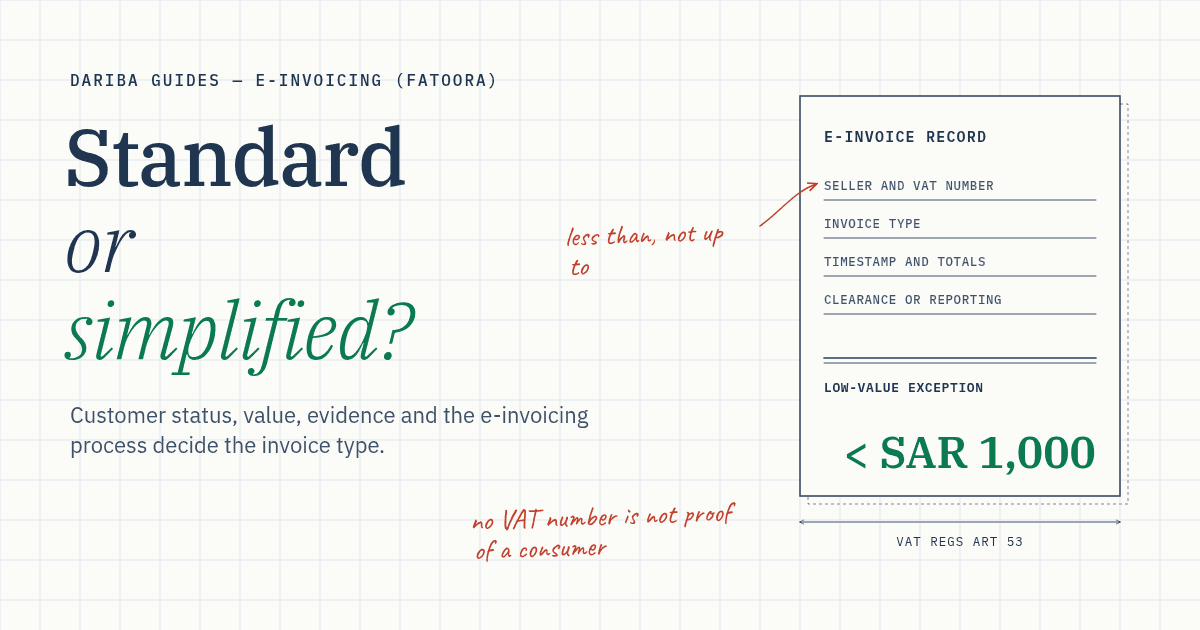
The permitted use of simplified form remains a separate test under Article 53. A document labelled “receipt” does not automatically satisfy it, and a supplier cannot use the low-value exception without meeting its conditions and exclusions. Standard form may be a procurement preference, but that preference is not a universal statutory denial of simplified-invoice evidence.
Article 49(7) also provides other specified evidence routes, including commercial documents allowed at ZATCA’s discretion. That discretion should not be rewritten as an automatic entitlement. The May 2026 Tax Invoicing and Records Guideline, section 9.5, distinguishes correctly issued simplified invoices from incomplete invoices and other alternative evidence. See the invoice-type comparison and input VAT recovery for the wider conditions.
Fully Exempt Supplies Are Outside the Specified Transaction Scope
Implementation Resolution First 5–7 distinguishes taxable supplies from excluded transactions. Zero-rated supplies remain taxable. Fully exempt supplies and their advances are excluded, as are reverse-charge supplies and goods imports.
| Transaction or evidence | What the VAT reconciliation needs |
|---|---|
| Standard-rated domestic sale | Correct tax point, taxable value, VAT and applicable invoice status |
| Zero-rated taxable sale | Legal zero-rating conditions, supporting evidence and required electronic treatment |
| Fully exempt supply | Exemption classification and commercial/tax records; no assumption that a mandatory FATOORA tax invoice is required solely because the supplier is registered |
| Goods import | Customs/import evidence and the applicable input-tax conditions, rather than a supplier FATOORA clearance match |
| Reverse-charge supply | Relevant commercial evidence and reverse-charge return treatment; excluded from the Resolution’s specified transaction scope |
| Document containing mixed elements | Classify the underlying supplies and reconcile their treatment; a zero amount is not a sufficient classification |
The applicable XML categories and reason data must follow the actual taxable treatment and technical requirements. A software code does not create an exemption, and platform acceptance does not prove that the legal conditions for zero-rating were met. The e-invoicing overview explains the scope boundary.
Credit and Debit Notes Need Both Legal and Electronic Treatment
VAT Implementing Regulations Article 40 addresses changes to supply value and the resulting adjustments. Article 54 governs credit/debit notes, including corrections to specified invoice information. The electronic route follows the relevant document type; it is not always clearance, because simplified notes use reporting.
Keep the original issued document and clearly link the note to the invoice or invoices being adjusted. Do not delete the original to make the ledger agree. The May 2026 invoicing guideline, sections 7.1–7.2, explains adjustments and permits a note covering multiple invoices to the same customer when the relevant invoices are clearly identified.
For the value-adjustment cases in Article 40, the return period follows the applicable rule:
| Adjustment | Relevant Article 40 timing |
|---|---|
| Supplier increase in output VAT | Period in which the adjustment-triggering event occurs, under paragraph 4 |
| Supplier decrease in output VAT | Later of the event period and the period of issuing the credit note, under paragraph 5 |
| Customer’s corresponding input adjustment under paragraph 6 | Period in which the credit or debit note is issued |
These rules should not be replaced by a claim that every adjustment belongs to whichever period FATOORA eventually clears a document. The electronic requirements still apply, but tax-point, adjustment and document obligations must each be satisfied. Article 54(6) generally requires issuance by the fifteenth day of the month following the relevant circumstances; the applicable facts and any separate return-error rules must also be checked. See credit and debit notes for the detailed distinction.
Build a Reconciliation Bridge Instead of Demanding Identical Totals
Dariba recommends reconciling the sales ledger, generated documents, FATOORA responses and VAT return before filing. A difference calls for an explanation; it is not automatically proof of an omitted sale or a required adjustment.
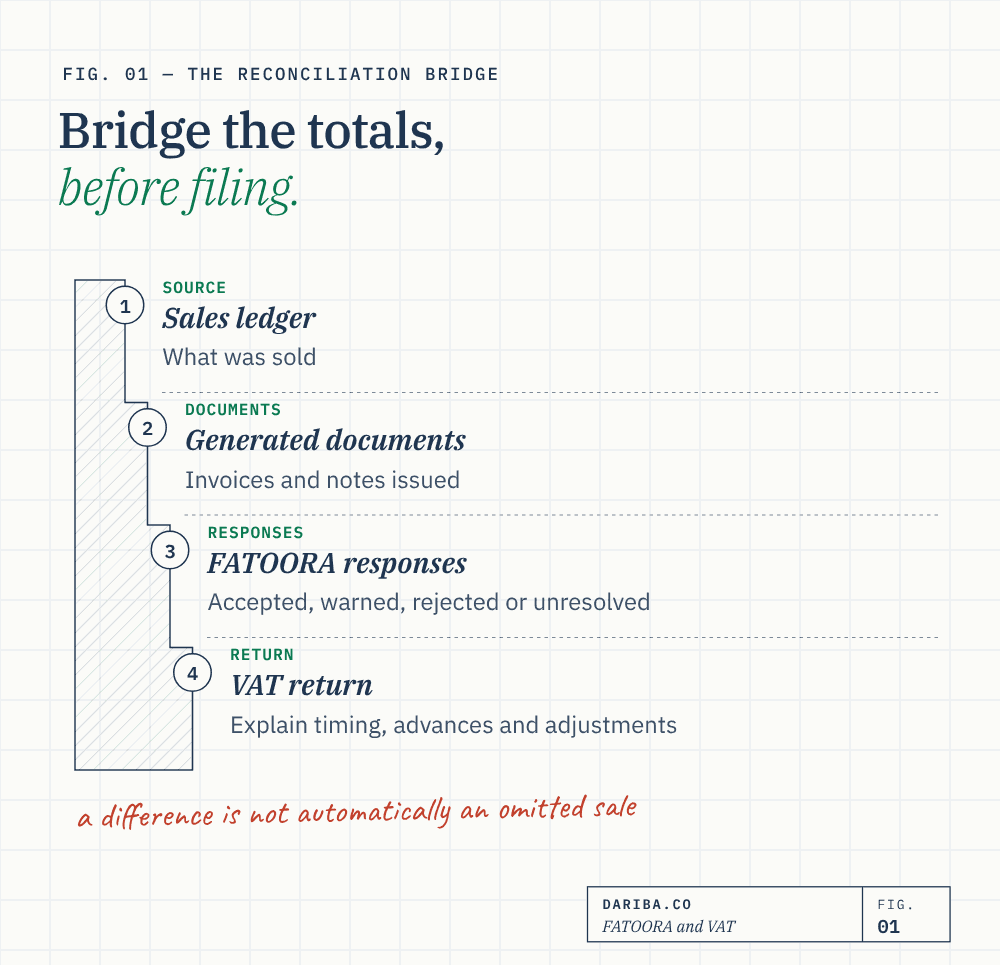
Separate genuine errors from legitimate differences caused by invoice timing, advances, qualifying adjustments and transactions supported by evidence outside this e-invoicing scope. On the purchase side, distinguish supplier electronic invoices, customs evidence and reverse-charge accounting. Also test input-tax eligibility, allocation and restrictions rather than comparing gross invoice totals alone.
Retain a list of unresolved submissions, rejected documents, accepted warnings and corrected new documents. Prevent retries or replacements from creating duplicate sales. Where invoice issuance and the VAT return period differ, record the statutory basis for the return treatment and retain the document trail. These are practical reconciliation controls, not a new statutory formula requiring every FATOORA total to equal every return box.
Preserve Evidence and Assess Penalties Separately
Resolution Fifth and VAT Implementing Regulations Article 66 govern the archive, access and retention requirements. Keep the original electronic records and responses, correction links and relevant incident communications available after migrations. Ordinary retention and the longer capital-asset rules should not be replaced by the assumption that FATOORA retains everything on the business’s behalf.
The Technical Guideline distinguishes VAT payment failures from failure to issue valid invoices. Assess the actual breach and the relevant penalty category separately. ZATCA’s current waiver announcement expressly excludes VAT Law Article 45 fines; an initiative end date is not blanket protection for e-invoicing failures. Use the penalties guide for the category-specific framework.
The practical objective is a defensible chain from transaction facts to tax treatment, document status, accounting entry and return. Preserve a stated uncertainty or seek clarification where the official material leaves a particular incident or evidence route unresolved.
Key takeaways
- VAT can become due even when an invoice is technically rejected.
- Article 49(7) recognises correctly issued simplified invoices as alternative deduction evidence.
- Fully exempt supplies, goods imports and reverse-charge supplies need distinct reconciliation treatment.
- Notes follow the relevant standard or simplified document route; originals remain preserved.
- Article 40 distinguishes supplier increases, supplier decreases and customer adjustment periods.
- Explain legitimate differences between FATOORA data and return boxes instead of requiring identical totals.
Sources
- ZATCA E-Invoicing Regulation, controlling Arabic textArticle 3: persons subject to the regulation and non-resident exclusion.
- ZATCA e-invoicing implementation controls, current Arabic publicationFirst to Seventh; Annexes One and Two: scope, evidence, document routes, controls and individual enforcement dates. Arabic text prevails.
- ZATCA English translation of the e-invoicing implementation controlsReading aid for First 3 and 5–7, Second 3, Third to Seventh and the annex enforcement tables; distinguish Phase 1 and Phase 2.
- ZATCA Detailed Guideline for E-Invoicing, second edition, May 2023Sections 2.3, 2.8, 4–7 and 10: invoice types, portal, generation/integration and qualified official failure scenarios.
- ZATCA Detailed Technical Guideline for E-InvoicingSections 3.5, 4.1–4.3 and 6 and rejection/failure FAQs: architecture, credentials, responses, sequence and QR distinctions. Differing simplified rejection answers remain qualified.
- Saudi VAT Implementing Regulations, current Arabic compilationArticles 40(1)–(6), 49(7), 53–54 and 66: adjustment periods, alternative deduction evidence, invoice and note conditions and records; operative text distinguished from comparison annex.
- ZATCA Arabic guide to classification of general VAT violations, second edition, May 2024E-invoicing items 8–18: category-specific warning, repeat and escalation rules. Detailed schedules remain in the linked penalty guide.
- ZATCA Tax Invoicing and Records Guideline, version 3, May 2026Sections 7.1–7.2 and 9.5: credit/debit notes, multiple-invoice references, adjustment/issuance timing and alternative input-tax evidence. Guidance read against current Arabic legislation.
- ZATCA penalty-waiver announcement, 29 June 2026Current extension to 31 December 2026 expressly excludes VAT Law Article 45 fines.
- Ministerial Decision 1117, official publicationOperative clauses First to Seventh: extension, specified covered relief, return cut-off and payment/instalment conditions; not blanket e-invoicing relief.
General information based on official sources reviewed on 29 October 2026. Arabic legislation controls. Transaction facts, actual integration duties, deduction evidence and the applicable adjustment rules determine the result. Platform acceptance is not independent tax certification; discretionary evidence and qualified incident procedures are not automatic relief.